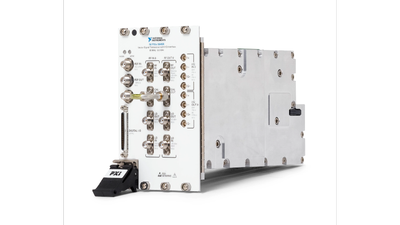
The PXIe-5645, previously known as the PXIe-5645R.
The PXIe‑5645 combines a vector signal generator and vector signal analyzer with FPGA-based real-time signal processing and control into a single device, also known as a VST. Because of this software-designed approach, the PXIe‑5645 offers the flexibility of a software defined radio architecture with RF instrument class performance.
The PXIe‑5645 features a high-performance, differential or single-ended baseband I/Q interface. This interface allows the PXIe‑5645 to address many additional applications, such as testing both the upconverted RF and downconverted baseband signals of a device with a single instrument.
The NI PXIe-5644R/5645R/5646R are comprised of a vector signal generator, vector signal analyzer, and digital I/O, the NI PXIe-5644R/5645R/5646R RF vector signal transceivers (VSTs) combine multiple instruments into a single PXI Express module. Backed by software to support the latest RF standards, including 802.11ac and LTE Advanced, NI vector signal transceivers boast the performance and flexibility of an R&D-grade box instrument with the speed, low cost, and small form factor of a manufacturing test system. In addition, NI vector signal transceivers have a user programmable FPGA at their core, making them software-designed instruments. This allows users to customize the firmware of their instrument down to the pin.
| Key Features |
| Vector signal analyzer and generator in a single PXI module |
| 65 MHz to 6 GHz frequency range |
| Up to 200 MHz instantaneous bandwidth |
| 24 channels of high-speed digital I/O up to 250 Mbit/s |
| Built on FPGA technology programmable with NI LabVIEW software |
| Industry-leading performance and test times for testing the latest wireless standards such as 802.11ac, including optional specifications |
| Easily expands to support multiple input, multiple output (MIMO) configurations or parallel testing in a single PXI chassis |
| Optional baseband I/Q interface with the NI PXIe-5645R |
| Specifications |
|
|
|
PXIe-5644R/5645R/5646R
RF Vector Signal Transceivers, 6 GHz
|
|
|
|
| RF Receiver |
|
|
|
| Model | PXIe-5644R | PXIe-5645R | PXIe-5646R |
| Frequency Range | 65 MHz to 6 GHz | 65 MHz to 6 GHz | 65 MHz to 6 GHz |
| Bandwidth | 80 MHz | 80 MHz | 200 MHz |
Phase Noise
(10 kHz offset) at 1 GHz
| -112 dBc/Hz | -112 dBc/Hz | -112 dBc/Hz |
| Absolute Amplitude Accuracy | ± 0.35 dB to ± 0.55 dB | ± 0.35 dB to ± 0.55 dB | ± 0.35 dB to ± 0.55 dB |
| Average Noise Floor | -161 dBm/Hz | -161 dBm/Hz | -161 dBm/Hz |
| Architecture | Zero-IF | Zero-IF | Zero-IF |
| List Mode | Yes | Yes | Yes |
| Peer to Peer Streaming | Yes | Yes | Yes |
Note:
NI vector signal transceivers feature a zero-IF receiver; allowing it to have higher potential bandwidths, lower cost, less power consumption, and a smaller footprint when compared to heterodyne receivers. Other advantages include simpler designs with single LOs, and high selectivity, which allows separation of adjacent channels whose signals overlap.
| Specifications |
|
|
|
PXIe-5644R/5645R/5646R
RF Vector Signal Transceivers, 6 GHz
|
|
|
|
| RF Transmitter |
|
|
|
| Model | PXIe-5644R | PXIe-5645R | PXIe-5646R |
| Frequency Range | 65 MHz to 6 GHz | 65 MHz to 6 GHz | 65 MHz to 6 GHz |
| Bandwidth | 80 MHz | 80 MHz | 200 MHz |
Phase Noise
(10 kHz offset) at 1 GHz
| -112 dBc/Hz | -112 dBc/Hz | -112 dBc/Hz |
Maximum Output Power
(CW)
| +10 dBm | +10 dBm | +10 dBm |
| Minimum Output Power | -168 dBm/Hz | -168 dBm/Hz | -168 dBm/Hz |
| Modulation Capabilities | Vector
Modulation
| Vector
Modulation
| Vector
Modulation
|
| RF List Mode | Yes | Yes | Yes |
| Tuning Time | 380 µs | 380 µs | 380 µs |
Note:
The NI vector signal transceiver RF transmitter uses direct RF up conversion from differential baseband I/Q, which up converts the baseband signal from DC to RF at the configured LO frequency.