
Quick quote: NI PXIe-5645R
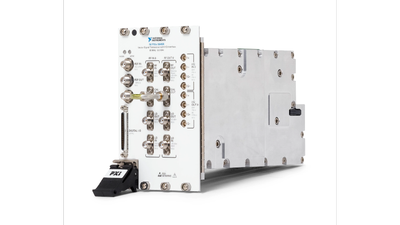
NI PXIe-5645R
Model
PXIe-5645RManufacturer
NIConfigured models contain the following attributes:
Let us help you with your exact configuration
Please use 'Get Quick Quote' and we’ll contact you and quote for your exact need.
You can also get in touch, if you prefer, and our experts will be able to guide you with the right application and procurement solution for this product.
Product Overview
The PXIe-5645, previously known as the PXIe-5645R.
The PXIe‑5645 combines a vector signal generator and vector signal analyzer with FPGA-based real-time signal processing and control into a single device, also known as a VST. Because of this software-designed approach, the PXIe‑5645 offers the flexibility of a software defined radio architecture with RF instrument class performance.
The PXIe‑5645 features a high-performance, differential or single-ended baseband I/Q interface. This interface allows the PXIe‑5645 to address many additional applications, such as testing both the upconverted RF and downconverted baseband signals of a device with a single instrument.
The NI PXIe-5644R/5645R/5646R are comprised of a vector signal generator, vector signal analyzer, and digital I/O, the NI PXIe-5644R/5645R/5646R RF vector signal transceivers (VSTs) combine multiple instruments into a single PXI Express module. Backed by software to support the latest RF standards, including 802.11ac and LTE Advanced, NI vector signal transceivers boast the performance and flexibility of an R&D-grade box instrument with the speed, low cost, and small form factor of a manufacturing test system. In addition, NI vector signal transceivers have a user programmable FPGA at their core, making them software-designed instruments. This allows users to customize the firmware of their instrument down to the pin.
| Key Features |
| Vector signal analyzer and generator in a single PXI module |
| 65 MHz to 6 GHz frequency range |
| Up to 200 MHz instantaneous bandwidth |
| 24 channels of high-speed digital I/O up to 250 Mbit/s |
| Built on FPGA technology programmable with NI LabVIEW software |
| Industry-leading performance and test times for testing the latest wireless standards such as 802.11ac, including optional specifications |
| Easily expands to support multiple input, multiple output (MIMO) configurations or parallel testing in a single PXI chassis |
| Optional baseband I/Q interface with the NI PXIe-5645R |
| Specifications | |||
PXIe-5644R/5645R/5646R RF Vector Signal Transceivers, 6 GHz | |||
| RF Receiver | |||
| Model | PXIe-5644R | PXIe-5645R | PXIe-5646R |
| Frequency Range | 65 MHz to 6 GHz | 65 MHz to 6 GHz | 65 MHz to 6 GHz |
| Bandwidth | 80 MHz | 80 MHz | 200 MHz |
Phase Noise (10 kHz offset) at 1 GHz | -112 dBc/Hz | -112 dBc/Hz | -112 dBc/Hz |
| Absolute Amplitude Accuracy | ± 0.35 dB to ± 0.55 dB | ± 0.35 dB to ± 0.55 dB | ± 0.35 dB to ± 0.55 dB |
| Average Noise Floor | -161 dBm/Hz | -161 dBm/Hz | -161 dBm/Hz |
| Architecture | Zero-IF | Zero-IF | Zero-IF |
| List Mode | Yes | Yes | Yes |
| Peer to Peer Streaming | Yes | Yes | Yes |
Note:
NI vector signal transceivers feature a zero-IF receiver; allowing it to have higher potential bandwidths, lower cost, less power consumption, and a smaller footprint when compared to heterodyne receivers. Other advantages include simpler designs with single LOs, and high selectivity, which allows separation of adjacent channels whose signals overlap.
| Specifications | |||
PXIe-5644R/5645R/5646R RF Vector Signal Transceivers, 6 GHz | |||
| RF Transmitter | |||
| Model | PXIe-5644R | PXIe-5645R | PXIe-5646R |
| Frequency Range | 65 MHz to 6 GHz | 65 MHz to 6 GHz | 65 MHz to 6 GHz |
| Bandwidth | 80 MHz | 80 MHz | 200 MHz |
Phase Noise (10 kHz offset) at 1 GHz | -112 dBc/Hz | -112 dBc/Hz | -112 dBc/Hz |
Maximum Output Power (CW) | +10 dBm | +10 dBm | +10 dBm |
| Minimum Output Power | -168 dBm/Hz | -168 dBm/Hz | -168 dBm/Hz |
| Modulation Capabilities | Vector Modulation | Vector Modulation | Vector Modulation |
| RF List Mode | Yes | Yes | Yes |
| Tuning Time | 380 µs | 380 µs | 380 µs |
Note:
The NI vector signal transceiver RF transmitter uses direct RF up conversion from differential baseband I/Q, which up converts the baseband signal from DC to RF at the configured LO frequency.
Resources
File resources
Can't find what you are looking for?
Get in touch